|
|
Frank J. Zamboni &
|
 |
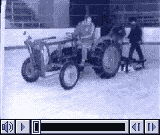
Prior to the invention of the Zamboni, ice was resurfaced by attaching a planer to a wagon and adding a sleigh behind it. There were snow catchers who lifted up the back of the plow, dropped it to release the snow, and men who scraped and swept up excess ice and snow. The ice was then sprayed with a large hose and "squeegee men" would push away excess dirty water. A final layer of water created a smooth, shiny finish. The full process took up to two hours, although scraping the ice was a 20-30 minute quick fix. Frank Zamboni, builder and manager of the Iceland Skating Rink in Paramount, California, thought there must be a better way. The first attempt at a Zamboni was a sled towed behind a tractor; resurfacing still required a lot of additional human effort. By the summer of 1949, Frank built a machine using a Jeep Chassis that did a complete resurfacing job all in one: cut ice, remove snow, wash and squeegee ice, leave a thin film of water, hold all the excessive snow -- and produce a consistently good sheet of ice. The model was patented the Model A Zamboni Ice Resurfacer. Ice Queen Sonja Henie saw the Zamboni at the Paramount when she was practicing for Ice Follies, and she requested that Frank build her one for the show tour. The exposure of the Zamboni in Canada and Europe was soon followed by a Zamboni presence at 1960 Olympics in Squaw Valley, California, where the U.S. Olympic hockey team, lead by Captain Jack Kirrane, took the gold. Sales orders soon arrived from Europe, Japan, and Australia. Important landmarks in Zamboni evolution: the dump mechanism and the Zamboni designed chassis were incorporated in 1964. Infinitely variable transmission arrived in 1969. The Electric Model (552) is now available for the eco-conscious consumer. Further history is available at the Zamboni company website. 
|
  
|
||